Agile Execution & Interim Leadership as a Strategic Advantage in Latam
Why speed of operational execution outperforms delayed permanent recruitment during international market expansion.
The Architecture of Growth Gaps
Leadership voids within multinational corporate networks rarely emerge from a failure in macroeconomic planning or long-term vision; rather, they manifest as critical operational frictions during high-velocity deployment phases, such as cross-border market entry, sudden structural mergers, or sudden asset reorganizations. When a global corporation or an investment fund decides to scale operations into Latin America, translating high-level headquarters strategy into predictable local subsidiary revenue requires immediate, boots-on-the-ground decisiveness and deep regional market knowledge.
The standard corporate playbook for managing territory development or executive leadership transitions typically dictates launching an extended, high-compliance executive search (Headhunting). Corporate boards operate under the comforting but flawed assumption that waiting six to nine months to onboard the "ideal" permanent executive justifies a temporary operational pause. However, in the high-stakes arena of cross-border execution, leadership vacancies are never financially neutral. While corporate headquarters coordinates lengthy remote interviews across time zones, local market decision-making slows to a crawl, regulatory deadlines begin to slip, and initial expansion momentum encounters crippling institutional inertia.
The Financial Cost of Delayed Alignment
In highly dynamic and volatile emerging economies, allowing leadership voids to persist in local subsidiaries has evolved into a major corporate liability. Ongoing macroeconomic shifts, complex localized tax compliance frameworks, and highly agile regional competitors aggregate during directorship gaps, turning an administrative pause into a severe erosion of overall market equity. This strategic drag compromises corporate capital efficiency across three distinct layers:
Erosion of First-Mover Advantage Delayed launch timelines and slow localized entity formation grant direct territory dominance and premium market share to local competitors who operate with structural immediacy.
Regulatory & Operational Exposure Compounding friction within regional Soft Landing frameworks. The lack of an authoritative, senior-level signature on the ground gridlocks essential logistics, labor contracts, and crucial transborder infrastructure deployment.
Capital Asset Underperformance Stalled utilization of allocated CapEx, resulting in underperforming regional business units that systematically fail to meet initial quarterly P&L projections mandated by the global board.
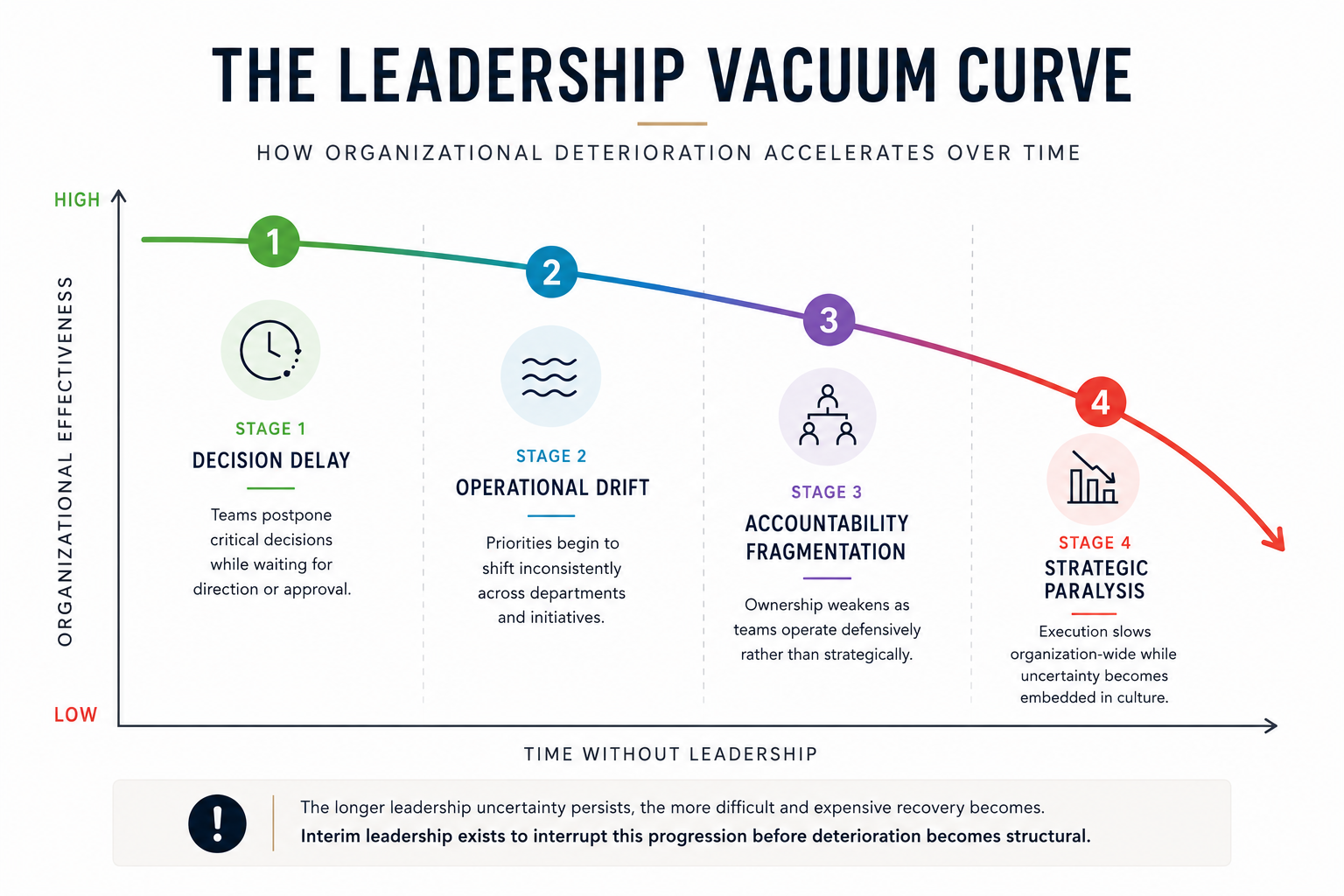
The Cross-Border Vacuum Curve
When an international corporate deployment operates without localized, senior-level accountability, the regional project predictably trends downward through a compounding cycle of execution friction, moving through four definitive structural phases:
Phase 1 — Velocity Deceleration In the absence of clear, localized governance, on-site management teams instinctively postpone critical operational and legal commitments, waiting for distant headquarter clearances.
Phase 2 — Strategic Disalignment Operational and corporate priorities begin to drift inconsistently. Local distributors, key supply chain partners, and internal business departments start establishing conflicting agendas.
Phase 3 — Accountability Fragmentation Contractual agreements, compliance metrics, and commercial pipeline ownership deteriorate as local teams abandon strategic growth to focus entirely on administrative self-preservation and political buck-passing.
Phase 4 — Market Paralysis Execution halts entirely organization-wide, driving corporate headquarters into a high-cost turnaround, asset recovery, or legal distress scenario before the expansion model has even fully matured.
Asymmetry in Action: Speed as a Core Asset
Interim Management directly resolves this velocity dilemma. By injecting a veteran, bicultural executive with extensive transborder deployment experience within a matter of days, a multinational corporation establishes an immediate tactical asymmetry in the territory. While direct market competitors are still drafting profile requirements and screening resumes with headhunters, the agile corporation is already actively securing prime distribution networks, resolving customs bottlenecks, and protecting its market penetration metrics.
In the execution of cross-border expansions, speed is not merely an operational preference—it operates as a vital financial defense mechanism. An experienced Interim Director effectively stabilizes the localized operational framework, mitigates immediate compliance exposures, and enforces corporate governance. This ensures that when the permanent executive eventually takes the helm, they inherit a functional, synchronized, and revenue-generating engine rather than an operational rescue project under financial distress.
Execution Without Corporate Politics
The definitive strategic value of an Interim Executive lies in their complete structural objectivity. Because their mandate is explicitly bounded by rigorous milestones—such as stabilizing a rocky corporate expansion, managing a localized restructuring phase, or driving post-acquisition integration—they remain entirely insulated from internal corporate politics, long-term career maneuvering, or regional power struggles.
Their operational focus is hyper-targeted: implementing clear corporate guidelines, optimizing localized supply chains, aggressively protecting the regional P&L, and bridging the structural communication gap between global headquarters and local deployment. They do not manage for corporate perception or corporate ladder optics; they execute strictly for measurable, contractually mandated results.
Deploy Immediate Leadership
Minimize execution risk, break through institutional inertia, and secure your expansion roadmap in Latin America without administrative delays. Let us talk via LinkedIn to evaluate a high-velocity transition mandate for your regional operations.
Connect on LinkedIn